Saturday, 1 September 2018

THE GIVER OF JOY THROUGH DHAMMA

Portrait of the Late Chief
He was just like a comet, leaving trails of stardust that would fall to Earth despite being absent, creating beautiful showers decorating the night skies. He had left a great legacy, a legacy for us to appreciate, learn and practise. His legacy has been inspiring thousands, maybe millions. He is non other than the late "Chief Reverend", Datuk K. Sri Dhammananda Nāyaka Mahā Thera, the one who experience joy through Dhamma.

I've never met this unique monk before, but through his interesting books, insightful yet humorous recorded talks, and the impactful sharing from his close Dhammaduta devotees, I believe he was indeed a great teacher that had gave joy through his Dhamma teachings. I first approached Dhamma through his masterpiece, "What Buddhists Believe", which conditioned myself to start paying interests in the Dhamma learnings. His recorded talks, which are available in youtube, were inspiring and insightful, yet humorous. In one of his talk about the "Three Basic Principles in Human Life", he mentioned that according to his observation, Chinese are the cleverest people in this world, as they are the only people who open a bank in hell. That was one of the impactful and insightful remark that had brought me to ponder on about the paper-burning culture.
What Buddhists Believe by Late Chief
Of course, there are other talks of his that I've felt inspired with. Yesterday, I went to an exhibition organised by the Buddhist Gem Fellowship in Buddhist Maha Vihara in tribute to the Late Chief. While looking at the pictures of the Late Chief, a great sense of gratitude automatically arose within me. What touches the most in the exhibition is the dedication written by the Late Chief's Muslim godson, Dr Amir Farid. It was written that Dr Amir had always find Late Chief when he's still around and even addressed the Late Chief as "Daddy". The Late Chief even had been mindful of Dr Amir's solat practise and had offered his private room to Dr Amir for his prayers during his solat periods. That's how considerate and compassionate the Late Chief was. I almost teared viewing on the funeral photos of the Late Chief. I could feel that it was indeed a great loss to the Buddhist community, especially those who are close to the Late Chief.


Bro. Datuk Victor Wee explaining on the Late Chief's homeland
Late Chief's room which was well-preserved and displayed

Ven. Mahinda joyfully looking at the Late Chief's cartoon stature


He has passed away since 12 years ago, when I was just Form 3 preparing for my PMR that year. Although I have never see him nor associate with him, but the legacy that he left had impacted me a lot. I really experienced Dhamma joy through his legacy. Thank you, Late Chief for being an indirect teacher to me. I aspire to put effort in encouraging Buddhist education and continue on the upward path until the liberation from afflictions is attained. Vayadhāmma sankhara, apamadena sampādetha!


The Future of Buddhism in Malaysia by the Late Chief Rev. K. Sri Dhammananda

Thank you, Late Chief...

Saturday, 26 May 2018

DHAMMAYATRA '17 (PART VIII): SHORT VISIT TO THE CITY OF NINE GEMS

At the Suvarnabhumi Airport and before boarding the bus to the Bangkok Palace Hotel for our transit stay, Bro. Tan explained to us that this city has the longest name and is recorded in the Guinness Book of Records. Initially, I was surprised and wondered how come the word "Bangkok" can be the longest name? Well, actually "Bangkok" is the city's English name. It's ceremonial name, which is known to the locals is "Krungthepmahanakhon amonrattanakosin mahintharayutthaya mahadilokphop noppharatratchathaniburirom udomratchaniwetmahasathan amonphimanawatansathit aakkathattiyawitsanukamprasit," which means "City of angels, great city of immortals, magnificent city of the nine gems, seat of the king, city of royal palaces, home of gods incarnate, erected by Vishvakarman at Indra's behest." Well, indeed it's very very long to be remembered. So, it usually being called "Krungthep" instead of it's longer version. That's quite interesting though.

Wat Saket
The next morning, after our breakfast, we checked out from the hotel and visited Wat Saket, the Temple of Golden Mount. A portion of the Buddha relics unearthed back at Piprahwa was enshrined here. It is also known as "Chedi Phukhao Thong" to the locals, which means the "Buddhist Tower of the Phukhao Thong Village." Here, the main shrine hall are surrounded by the sima stone foundations. And we could also understood from Bro. Tan that all Thai temples have a common, significant roof architecture of Garudas and Nagas in it. There was a legend where the Garuda and Naga are nemesis to each other. However, in the presence of the Blessed One, both of them were able to interact harmoniously. There's a saying where in Thai tradition, every Thai young man will have to novitiate as a monk upon achieving the age 18.

Wat Arun
Next, we boarded a boat at the Chao Phraya River and went to a fish-feeding spot before proceeding to Wat Arun. Some of the residence here are only accessible via river boat. However, due to inconvenience today, some of the residence were abandoned. There are also floating markets every morning around the riverside according to the tour guide. Then, we visited Wat Arun, also known as the "Temple of the Dawn". The temple is only accessible via Chao Phraya River Boat. During some royal occasions such as the coronation of the New King, the Royal Bath will be held along the river, where the Chao Phraya River and Wat Arun will be inaccessible to the outsiders. The architecture of Wat Arun is somewhat unique where it was mostly made up of porcelain with heavy elements of Hindu-Buddhism. 

At Wat Arun, Bro Tan reminded us that despite the changes of era from conventional to modern, the law of kamma still operates, no one can ever escape of it. Despite having so many decades to go, we're still inexperienced, making us ignorant of many things. We shouldn't feel superior, conceited or proud as these are the causes of downfall. We're in fact still unknown to the subtle real conditions that brought us here. That's why, kalyana mitta is important in bringing the best and wholesome out of us as well as serving as a fuel in sustaining our Dhamma practise. Kalyana mitta is not just an ordinary good friend. He is a wise friend with good vijja-carana (knowledge & conduct) who'll encourage us to live in accordance to the Dhamma and remind us when we are off-track from the Dhamma practise. Hence, Bro Tan reminded us not to find kalyana mittas just by their look, but by their quality of wisdom.

We boarded the plane back to Kuala Lumpur at 2:30pm while bidding farewell to Bro Tan as he'll be staying back in Bangkok for a few days. We touched down safely at 8:30pm in KLIA. With this Dhammayatra journey has ended, there marks the beginning of my life Dhammayatra, a life with self-transformation, cultivation of wholesomeness and wholesome aspirations.


Idam vo puññam asavakkhaya'vaham hotu
Idam vo puññam nibbanassa pacayo hotu
Idam vo ñatinam hotu sukhita hontu ñatayo
Imam no puñña bhagam sabbasattanam dema
Idam vo puññam Buddhasasanam ciram titthātu

May this merit lead us to the eradication of suffering
May this merit lead us to Nibbana
May this merit be share with our departed relatives and may they be happy
May this merit be shared with all beings
With this merit, may the Buddha-sasana long endure

My life journey of Dhammayatra shall continue until deathlessness is achieved!


Thursday, 22 March 2018

DHAMMAYATRA '17 (PART VII): ISIPATANA, TURNING OF THE DHAMMA-WHEEL BY THE BLESSED ONE

Samkampayam dasa-sahassiya-loka-dhātum,
Desesi yatra Bhagavā varadhammacakkam,
Bārānasī purasamīpavane migānam,
Tam Dhammacetiyamaham vandāmi

Varanasi (Baranasi/Benares)
Varanasi was our last stop throughout our pilgrimage in India. A very long, bumpy and breathtaking journey we had from Sravasti. We arrived at Varanasi almost midnight. Among the stops that we had went to, Varanasi is the only stop which I considered more urban and developed. Located at the bank of the River of Ganga in Uttar Pradesh, Varanasi was once the settlement of the Aryans and is one of the very popular in this district. It was named after River Varuna and River Assi. Varanasi is a sacred place for the Hindus as it was believed to be created by Lord Shiva. Varanasi is sometimes referred to as Benares, Baranasi or Kashi. In suttas, one might comes across terms like "sandalwood from Kashi", the Kashi here is definitely referring to this place called Varanasi. Items such as the sandalwood as mentioned are of the finest and highest quality which a very rich person, notably those from the royalty, can afford in the ancient times. 

Sarnath (Isipatana)
The next morning after a great rest, we travelled about 15 minutes to Sarnath, a town next to Varanasi. Sarnath was known as Isipatana in the ancient times, where it means the place where sages land. Upon entering Sarnath, one would notice a pyramidal-liked shape brick structure just on the left. The structure was known as Chaukhandi Stupa. Built during the Gupta Period, this stupa marks the site where the five ascetics first met and receive Lord Buddha who had travelled from Uruvela after his enlightenment. The octagonal structure on top of the stupa was later erected by Akbar, a Mughal ruler back then, to commemorate the visit of his father, Humayun to that spot. The structure had remained until today.
Chaukhandi Stupa with a commemorative octagonal tower erected on top
Just about 5km away from Chaukhandi Stupa, locates the most important site in Buddhist history, the Deer's Park. Deer's Park or Migadaya in the ancient times was the site where Lord Buddha preach the Dhamma for the first time to the five ascetics, hence setting the Dhamma wheel (dhammacakka) in motion. The sutta was hence named Dhammacakkapavattana Sutta or the Discourse of Turning of the Dhamma Wheel, where the Buddha first expounded the Four Noble Truth (cattāri ariyasacca) and introduced the Noble Eightfold Path (ariyo aṭṭhaṅgiko magga) as the Middle Path (majjhimā patipadā) to be practised to free oneself from the samsaric cycle and hence attain nibbāna, the Ultimate Bliss. Just not far from the entrance locates the ruins of the Dhammarajika stupa which
Ruins of Dhammarajika Stupa
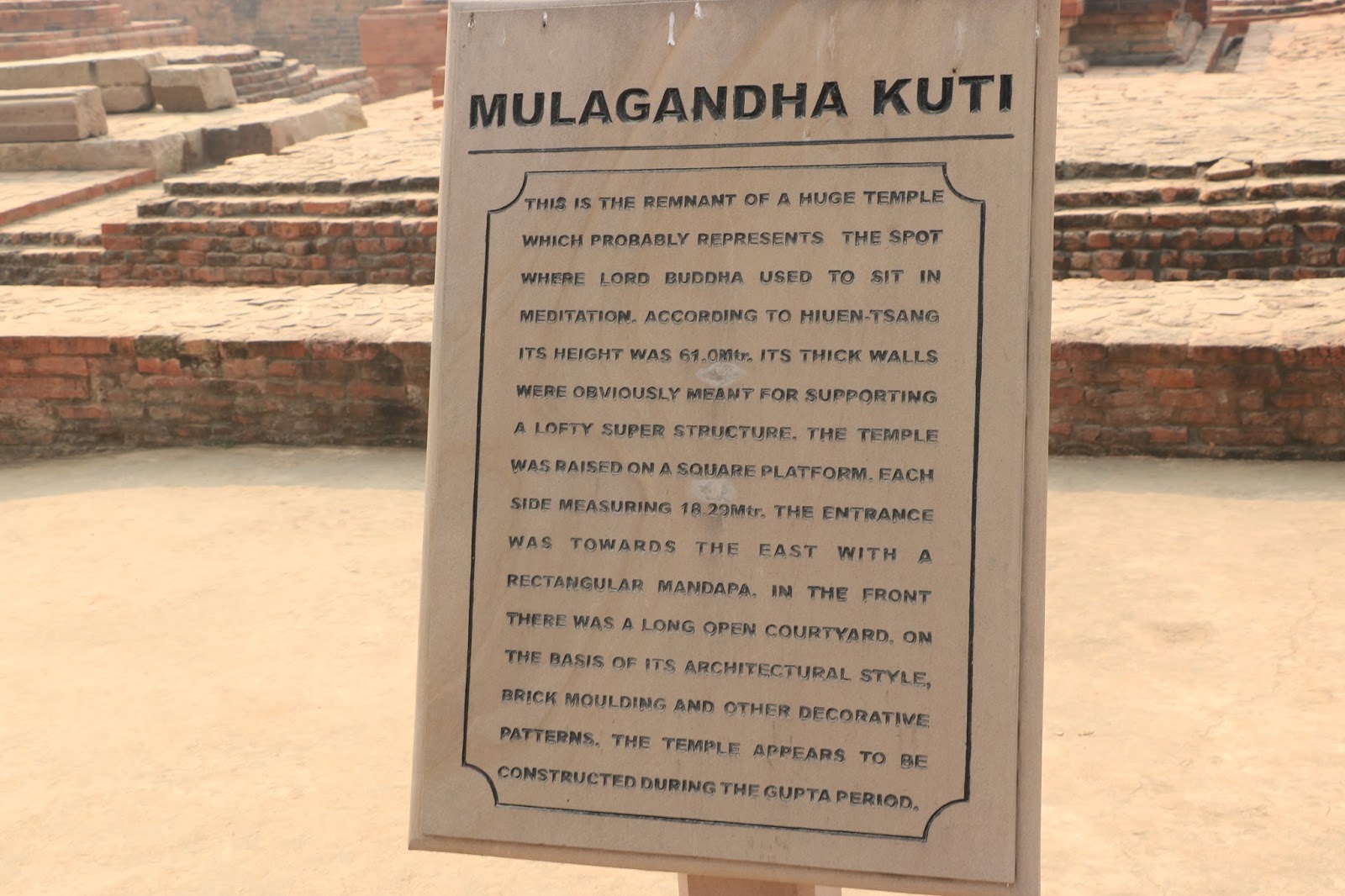
was built by King Asoka to commemorate the historical event. The original stupa was unfortunately destructed by Jagat Singh, a minister in Varanasi during the late 18th century in development of housing colony there, with the Buddha relic that was once enshrined here discarded, thinking that the relic is just a piece of junk rock. What is left is just the circular base of the stupa. Just beside the stupa is the ruins of the Mulagandhakuti or the First Perfumed Shrine where the Buddha spent his first rain retreat there. Located just beside the chamber is the fragments of the Asokan Pillar in Isipatana. The pillar fragments was enclosed with a transparent casing with the inscription still visible on the pillar. The Lion Capital of the pillar was displayed in the Sarnath Museum with other artifacts unearthed here in Migadaya.
Ruins of Mulagandhakuti
Description about the Mulagandhakuti
Fragments of Asokan Pillar

Description about the Asokan Pillar


Located not far towards the east was the Pancayatana Cetiya or the Shrine of Five Bases, the site where it was believed that the ordination of a rich man, Yasa as the Lord Buddha's sixth bhikkhu took place. In fact, Ven. Yasa's parents and siblings were the first batch of Lord Buddha's lay disciples. Amazingly, the texture and patterns engraved terracotta brick-made shrine were still clearly visible.
Remnants of Pancayatana Cetiya
Dhamekh Stupa or Dhamakha, the most prominent structure in Sarnath, was located further east from the Dhammarajika Stupa. The location of the stupa was believed to be the site where Lord Buddha expounded the second sermon, Anattalakkhana Sutta, the Discourse of Non-Self, where upon the accomplishment of the sermon, all the five ascetics attained Arahantship. There are burnt marks visible on the stupa which was believed to be the result of Jagat Singh's action. Here in Migadaya, Bro Tan shared with us the content of the Dhammacakkapavattana Sutta, including the two extremes to be avoided, the four noble truths and their aspects. At the end of the discourse, it was mentioned that only Ven. Kondañña understood the Lord's teaching at that time.
Dhamekh Stupa
Sarnath Archaeological Museum

In the afternoon, we visited the Sarnath Archaeological Museum, where most of the artifacts unearthed in Migadaya were put to display there, including the Lion Capital of the Asokan Pillar as well as some other Hindu artifacts. Due to the restriction by the museum authority, we were not allowed to bring any gadgets or devices into the museum. So, no pictures are taken for this visit. Anyway, we are so glad that we manage to see the polished sandstone-made Lion Capital which was still looks shiny as well as the well-carved Preaching Buddha-rupa. During the excursion, I got to know that actually the carvings of four animals that appeared on the Lion Capital represented the Blessed One's personalities and characteristics: Elephant - strength and latent tenacity; Bull - leadership and perseverance; Horse - swift and well-disciplined; Lion - fearlessness.


Mulagandha Kuti Vihara
In the evening, we went to the Mulagandha Kuti Vihara for our evening puja. Mulagandha Kuti Vihara was built by the Maha Bodhi Society under the efforts of Anagarika Dharmapala with financial assistance from Mrs Mary Elizabeth Foster of Hawaii in 1931. The Dhammacakkapavattana Sutta of different languages were displayed here. We also chanted the sutta for our evening puja. Fortunately, we also had the opportunity to pay our homage to the Buddha relics enshrined there. After that, we paid a short visit to the Jambudvipa Sri Lankan Buddhist Temple located not far from this vihara before returning to Varanasi.
Mulagandhakuti Vihara


River of Ganga
The next morning, we were excited to have the chance to go for a dawn cruise along the River of Ganga, the place which was deemed sacred to the Hindu communities in India. Various religious activities connected to their Hinduism culture were seen performed by the river. There are also some Indians performing laundry by the river. We also had the opportunity to have a glimpse at the cremation ghat where the bodies of the dead will be cremated there. Out of respect to the families of the dead, we were advised to to snap any photo there, but just silently and reflectively observe the activities carried out at the cremation ghat. During our cruise at the cremation ghat, we were reminded by Bro Tan about the samsaric cycle.

"How many had carried us and teared for us? How many had we carried and teared for? How long we need to continue with these over and over again? Think about it."

Yup. Due to our habits or kilesa, often we fell for samsaric trap, and continue that over and over again. To stop ourselves from indulging further, the right cultivation of mind is required, and that shall be each and everyone of us as a Dhamma practitioners' aspiration in freeing ourselves from that cycle of pleasurables and miseries. We carried out our morning puja and chanted Karaniya Metta Sutta on-board after the sun rises.
Cruising along the Ganga River with some historical building structure located along the river

An Indian lady performing laundry by the river

Sunrise at the Ganga River

The river ghat where we departed from


Back in the hotel, we performed meal dāna to the Sangha members from a university in Varanasi. We even have some conversations with them. It was quite enjoyable. After having our lunch, we packed and depart for La Bahadu Shastri International Airport. We felt utmost gratitude to our tour guide, Bro Rahul, the bus driver and also his attendant for ensuring our Dhammayatra journey in India a smooth one. We departed for Bangkok at 4.30pm Indian time and reached the Suvarnabhumi Airport at 9.00pm of Bangkok time.

That's all for Baranasi and Isipatana, the site where the Blessed One expounded the Four Noble Truth for the first time, resulting in the forming of Sangha community and the completion of the three refuges.

My Dhammayatra journey continues in Bangkok...

Sunday, 25 February 2018

DHAMMAYATRA '17 (PART VI): SAVATTHI, THE CAPITAL OF GREAT KOSALAN KINGDOM

Piprahwa, new site of Kapilavatthu
We dropped by Piprahwa while we was travelling from Nepal to Sravasti. Piprahwa was dubbed the place where ancient city Kapilavatthu was located. In fact, the site in Piprahwa might be the new Kapilavatthu after the attack of King Vidudabha on the old site of Kapilavatthu in Tilaurakot. Here, fragments of Buddha relics was unearthed by the estate owner, William Claxton Peppe while he was excavating a large mound in his estate. The relics was then distributed to Thailand (enshrined in Wat Saket) and Sri Lanka (enshrined in Dipaduttamrama Stupa and Ruwanwelisaya Stupa) In Piprahwa, one could still find the ruins on monasteries built during Kusharna's period which surrounded the main stupa. There is also a big lotus pond near the site of the main stupa.
Ruins of foundation structures surrounding the main stupa in Piprahwa

A big lotus pond located near the ruins
Lotuses blooming in vibrant pinkish color

Sravasti, known as Savatthi during the Buddha's time, was the capital of the Kosala kingdom lead by King Pasenadi at that time. Savatthi came from the word "sabbam atthi" which means "everything is here." Here was the place where the well known Jetavana monasteries was located. Here too was the home to the generous and wealthy Sudatta, the Anāthapindika as well as Lady Visakha, who had donated Pubbarama to the Sangha community. Here, Lord Buddha had performed the yamaka pathihariya or the Twin Miracle to dispel the condemning heretics while departing to Tavatimsa Heaven to preach the Dhamma to his mother, Queen Maya who had been reborn into the deva realm. Here was also the place where Devadatta, who had created schism among the Sangha community and attempted to murder the Blessed One, fell to death upon trying to visit the Blessed One. Now, Savatthi is just an outskirt town with ruins and monasteries around surrounded by thick forests and bushes.
The panaromic view of current Savatthi

Sudatta Stupa
Early morning of the 11th day, we visited the monument which was believed to be built on the foundations of residence owned by Sudatta. The condition there was very foggy that time. The monument was hence known as Sudatta stupa or Anathāpindika Stupa. Sudatta was once a great lay devotee to the Blessed One and was a very generous merchant until he was known as Anathāpindika which mean "the one who gives alms to the unprotected." Sudatta was once a great benefactor and supporter of the Sangha community during the Lord Buddha's time. From the top of the monument, one could see the scenery of the once prosperous Savatthi which has now became a place occupied by forests. One has to be mindful while climbing the monument as there are deep hole at the top of the monuments.

A portion of the Sudatta stupa covered with fog
Angulimala Stupa
Just opposite the street from Sudatta stupa, locates the Angulimala stupa, the site where Ven. Angulimala was cremated. Angulimala was once known as Ahimsaka, which means "the harmless one." He was once a kind and appreciative medical student at Tāshi (now Afghanistan) and was favoured by his teacher due to his diligence in medical studies. Due to his achievements and his close association with the teacher, he was disliked by his study mates. In other words, his study mates had grew jealous on Ahimsaka. Due to that, they concocted their teacher in many ways so that the teacher will dislike Ahimsaka. Once and coincidentally, Ahimsaka was helping his teacher's wife while having a good chat. Seen by his jealous mates, they called their teacher to observe the situation while telling a lie out of jealousy to him that Ahimsaka is having secret affair with his wife, hence igniting the fire of aversion within the teacher. Feeling angered, the teacher told Ahimsaka to leave as he had studied enough. In request of wanting to present an honorary gift to the teacher as a token of gratitude, the teacher suggested to Ahimsaka to present a garland of 1000 fingers to him. Despite feeling shocked and reluctant, he accepted his teacher's suggestion to search for finger garlands. In the beginning, he went everywhere asking for finger to make garland but to no avail. Feeling desperate, he started killing people for their fingers to make garlands, hence he was since named Angulimala. As he kills more and more, his past evil kamma ripens, turning him into a crazy, ruthless murderer who seeks pleasure in killing others. Upon collecting 999 fingers with one more left, Angulimala's mother made effort to find Angulimala to stop his killing spree. In a mission to save Angulimala as well as to prevent Angulimala from performing garuka kamma by murdering his own mother, the Blessed One stepped in to lure Angulimala towards him. Having seen the Blessed One but not knowing who He is, Angulimala chased after the Blessed One with an intention to fulfill his 1000 finger garlands. But to no avail, Angulimala failed to chase after the Blessed One. Having felt tired, Angulimala told the Blessed One to stop. The Blessed One skillfully told Angulimala that he had stop killing long time ago and advised Angulimala too to stop killing. Upon realised his own mistake, Angulimala dropped his weapon, repented in front of the Blessed One and request to be ordained. Ven. Angulimala successfully achieved Arahantship with his diligent practise. Despite being a monk, he was not escaped from the fruits of his bad deeds. He was thrown stones, spitted, beated and injured in many ways by the people everytime he goes for alms-round. Despite all these, Ven. Angulimala patiently and understandingly bore with them after having listened to the Blessed One advice to bear with all those adversities. Not long after, Ven. Angulimala entered Maha Parinibbāna due to all those serious injuries that he had sustained. This story of Ven. Angulimala had taught me the consequences of jealousy in harming oneself as well as others and how believing in the wrong views would cause harmful to oneself and others. And the most important lesson that I've learned is, be patient throughout our lives. We might not know what bad kamma we had done in the past causing the result of the unwholesome kamma to arise. With understanding, only we would able to put a stop to the ripening of our bad kamma while patiently endure all adversities that will happen to us due to our past bad kammas.

Angulimala stupa, the cremation site of Ven. Angulimala

Jeta's Grove (Jetavana)
Sudatta first met the Blessed One in Rajagaha while he was on his business trip there. Upon the expounding of the Dhamma by the Blessed One to Sudatta, he achieved the attainment of stream-entry (sotapatti). Sudatta invited the Blessed One to Savatthi and planned to build a monastery for Him, to which the Blessed replied Sudatta that He loves peaceful places. Understanding the Blessed
Anathāpindika Monastery in Jetavana
Ananda Bodhi Tree
The small stupa marking the verandah of the Gandha-kuti

One's request, Sudatta immediately searched for a location appropriate for the monastery as soon as he returned to Savatthi. In Savatthi, he spotted a park, strategic for the monastery to be established as the park was quite a distance away from the city's noise and yet not that very remote for the Sangha community to perform their alms-collection as well as for the devotees to pay visit to the Blessed One. However, the park was owned by Prince Jeta of Kosala. When Sudatta went to request to purchase the park, Prince Jeta replied in a rejecting manner that he wouldn't sell even if he could cover the whole place with gold coins. Surprisingly, Sudatta took Prince Jeta's word seriously. The next day, he sent a cart of gold coins and start covering the park with the coins laid side by side, but only a small spot was covered. Inspired by Sudatta's earnestness, Prince Jeta agreed to give away the park to be made a residence for the Sangha community. While the remaining gold coins was used to establish monastery structures. Hence, the park was named after Prince Jeta while the monasteries was named after Anathāpindika (Sudatta). In the middle of the park, stood a large Bodhi tree at a request by Ven. Ananda assisted by Sudatta. The Bodhi tree was believed to be the seedling from the original Bodhi tree where the Blessed One gained enlightenment. The seedling was obtained by Ven. Maha Moggallana with his supernatural power, teleporting from Jetavana to Uruvela and back again with the tree's seedling. After planting work was done by Sudatta, the tree was consecrated with the Blessed One meditated overnight under the tree. The tree was named after Ven. Ananda as he was the one who requested for the tree planting, in compassion for the devotees of Savatthi who wishes to pay homage when the Blessed One was away from Jetavana. Not far from the tree was once the Blessed One's resting chamber, known as Gandha-kuti or The Perfumed Chamber as the chamber was surrounded with perfumed flowers placed there by the devotees. We had our Mangala Sutta chant here right at the place where it was once the Blessed One's resting chamber. A verandah was once built just in front of the chamber, where the Blessed One used to preach the Dhamma to His discliples as well as the lay devotees. A small stupa which is now enveloped with golden leaves was erected, marking the place where the preaching verandah was located. Just beside the chamber is another small chamber built specially by Sudatta for the Blessed One's use for meditation purpose. Just in from of the chamber is a long brick-plinth where the Blessed One used to performed his walking meditation (cankama). The chamber was known as the Kosambi-kuti. Majority of the vinayas and suttas, including Metta Sutta and Mangala Sutta, were expounded here in Jetavana. It was said that this place has been the headquarter among the monasteries in ancient India. Despite the discovery of Jetavana, there are still some ruins were yet to be unearthed and still buried beneath the mounds and soils overgrown with trees and bushes.

Some of the monasteries in Jetavana

The Miracle Stupa, Orajhar
Known as Orajha, the Great Miracle Stupa marks the place where the Blessed One performed yamaka-pātihāriya or the Twin Miracle to silent the heretics who had constantly condemn the Blessed One whilst ascending to the Tavatimsa Heaven to preach his mother, Queen Maya who had be reborn in the heaven. The event took place at the beginning of the Blessed One's seventh rain retreat. The stupa was located on top of a hillock not far from the Nikko Lotus Hotel, the hotel where we had stayed overnight in Savatthi. The place was known by the local as Buddha Airport, as the place was once where Lord Buddha levitated and ascended to the sky above as claimed by the locals.
The hillock of the Great Miracle Stupa, Orajha


Nava Jetavana Vihara
Just opposite Jetavana, locates the Nava Jetavana Vihara. We visited the monastery the night we reached Savatthi after a long travel from Piprahwa. Here, we were glad and joyful that we had the opportunity to be blessed with the Buddha relic by the abbot of the vihara and even see the relic with deep reverence as if the Blessed One was there. What attracted me in the vihara was the murals on the wall. Each of the mural depicts an event that had once occurred here in Savatthi during Lord Buddha's time. Most of the stories were events that had taken place that conditioned the Blessed One to recite some of the verses in Dhammapada.
Being blessed by the abbot of Nava Jetavana Vihara with the Buddha relic

The Buddha-rupam of Nava Jetavana Vihara
One of the vihara's wall mural, depicting the Twin Miracle (yamaka-pātihāriya) event
That's all for Savatthi, the city where the Blessed One had spent almost half of His total rain retreats (vassas) before entering Maha Parinibbāna and was once the capital of the Kosala kingdom ruled by King Pasenadi.

My Dhammayatra journey continues...

Saturday, 6 January 2018

DHAMMAYATRA '17 (PART V): LUMBINI, THE LAST BIRTH OF SIDDHATTA

Māyāsuto Sugatasākya sīhanātho,
Jātakkhane sapadasā'va bhisamkamitvā
Yasmim udīrayi giram vara lumbinimhi,
Tam jātacetiyamaham vandāmi

Lumbini Park
Entrance arch to Lumbini Park
Lumbini or Lumbini Sanskritik is a place located just at the south of Nepal. Well-known for the site where Queen Mayadevi gave birth to Prince Siddhatta, Lumbini is located about 40 minutes of driving distance from Sonauli, the India-Nepal border. It is said that Queen Mayadevi was on her way back to her home country in Devadaha of Koliya kingdom when her birth pangs stroked while she was resting at Lumbini, a park located between Kapilavatthu and her home country. The site in which Prince Siddhatta was born is enclosed in the Mayadevi Vihara. Surrounding the vihara was some of the remaining ruins, a pond believed to be the place where the queen took her bath, and the damaged Asokan Pillar with Brahmi script erected during the King Asoka's pilgrimage to Lumbini. Due to the law forbidding cameras into the vihara, we're unable to capture any photo inside the vihara. Lumbini Park was designated by the Nepali authorities as the place for Buddhist temples and monasteries. Besides Mayadevi Vihara, there are other temples and monasteries as well, divided into temples of Mahayanan and Theravadan tradition with a canal in the middle. Each of the temple was represented by a country. During our tour in Lumbini Park, we managed to visit the temples of Burmese and German. To my surprise, the German stupa looks very Tibetan.
Mayadevi Vihara surrounded by the ruins


The pond beside Mayadevi Vihara that was believed to be the bathing place of Queen Mayadevi during her rest
The Brahmi scripts still visible on the Asokan Pillar
Translation of the Brahmi scripts engraved on the Asokan Pillar
A canal in Lumbini Park, dividing Mahayana and Theravadan monasteries, with the Santi Stupa far in the middle
The Burmese Temple in Lumbini Park
The Great Drigung Kagyud Lotus Stupa of German
The night after we toured Lumbini Park, we were honoured to have a Q&A session with Dr Basanta Bidari, the chief archaeologist responsible in discovering Lunbini Park as well as the Nigrodharama in Kudan near Tilaurakot, the Old Kapilavatthu. We really felt gratitude towards Dr. Basanti and his team for their effort in excavating the sites related to Buddhism. It's not easy for them to just discover the site. Behind the discovery, there are sacrifices of time, money and even mental energy.
Dr. Basanta Bidari as the honoured guest with Bro Tan

Tilaurakot, old site of Kapilavatthu
The location of ruins in Tilaurakot today was the place where the country of Kapilavatthu was located before the attack of King Vidudabha of Kosala. Kapilavatthu was once a prosperous country due to its large paddy production. King Suddhodāna, father of Prince Siddhatta, leader of the Sakyan clan and the ruler of Kapilavatthu by then, was named after rice, where his name bore the meaning "the one growing pure rice." The remains of the ruins at the site comprised of old monasteries and other ancient building structures. One could still see the site of the Eastern Gate of the old Kapilavatthu or The Gate of Great Renunciation (Mahabhinikkhamam Dvara), the gate where Prince Siddhatta left the palace for Anoma River to renounce. The excavation at the site of the ruins is still ongoing today.
Some of the excavated ruins at Tilaurakot
The remains of Eastern Gate of Kapilavatthu, Mahabhinikkhamam Dvara
The kingdom of Kapilavatthu faces its downfall after being attacked by King Vidudabha, the son and successor of King Pasenadi who had vowed for revenge against the Sakyans due to their humiliation against him. This had showed how the unwholesome behaviour of the royal Sakyans and the power of King Vidudabha's aversion brought downfall to a whole kingdom. This was the event where the Blessed One had defended Kapilavatthu from king's attack twice, but failed at the third attempt. King Vidudabha finally faces his mortality due to a sudden flash flood while he and his army were resting at the dry river bed of Achiravati River. Due to mortality of the Kosala's king, King Ajattasattu manage to take over the Kosala kingdom. The survivors who manage to evade the attack were believed to have escaped to the site of current Piprahwa in India, located about 30 km south of Tilaurakot, and established the new Kapilavatthu there. Located just nearby the site of ancient city Kapilavatthu was the twin stupa, which was erected to remember King Suddhodāna and Queen Mayadevi. Here, we circumambulated the stupa and made aspirations in gratitude for our parents.
Twin Stupa
Kudan, site of Nigrodharama
Just a few kilometers away from Tilaurakot was a place named Kudan, the site where Nigrodharama or the Banyan Grove was located. Nigrodharama was offered by King Suddhodāna to Lord Buddha and the Sangha community. During His visit to Kapilavatthu, the Blessed One would stay at Nigrodharama. A few notable suttas include the Madhupindika Sutta, Discourse of the Honey Ball (MN 18) was expounded at this place. There are remains of brick foundations of monasteries still visible here in Nigrodharama. Here too was the place where Ven. Rahula was ordained as a novice monk upon asking for his inheritance of Lord Buddha, who was also his father. A mound stupa was erected at a spot in Nigrodharama to commemorate the ordination of Ven. Rahula. The stupa was named Rahula Stupa. An old Hindu worship booth was built on top of the stupa before it was discovered as the site of Nigrodharama. The structure was still visible today.

Ruins of monasteries in Nigrodharama

Rahula stupa with an old Hindu worship structure built on top

Ramagama Stupa
Located about 50 km from Lumbini was the site of the Ramagama Stupa, the only original stupa still remained intact that contains the relics of Lord Buddha enshrined by the Koliyas of Ramagama. Located by the banks of Jahari River, this place serves as the best spot for open air meditation, in my opinion. 
The still-intact Ramagama Stupa
Circumambulating Ramagama Stupa while chanting Tiratanānusaranapātha


Rohini River

This river separates the kingdoms of the Sakyas and the Koliyas. There was an event where the two clans almost started a war over a quarrel on water resources for their respective agricultural activities, which had stemmed from their uncontentment. Lord Buddha had acted swiftly to intervene and stop the war from happening.
Rohini River, divider of the Sakyans and Koliyans

That's all for Lumbini, the site where the Blessed One was born for the last time; and Kapilavatthu, the country where the Bodhisatta had spent his first 29 years of his life before renouncing for the quest to Deathlessness.

My Dhammayatra journey continues...