Thursday, 11 May 2023

A REFLECTION ON KHANTĪ

While fetching my Dhamma mentor, Sis Paru back to her home, she shared with me about "khantī", a quality that's essential in developing virtues and mind training. 

Back during my undergraduate days, I was taught about the six pāramitā qualities essential to tho who're practicing the Bodhisattva-way, and one of qualities is non other than "kṣānti" or "忍辱". My understanding about is just merely patience. Breaking up the Chinese term "忍" which mean patience and "辱" which means insult, putting together the whole meaning would become "patience from insult". Well, that's really hard for me, especially when dealing with unreasonable people in the communities that I'm living in.

My gratitude to Sis Paru, the short sharing by her that night had enlightened me a bit about this. It's not just patience alone, but it's also forbearance with understanding. Each person comes from different background, hence its normal for people having different perspective and way of doing things, and that's the nature of life. I'm still human, and it's natural to have emotions.

Engage more with positivity and wholesomeness, Have hope, but expect less. Focus internally and externally on the process and learning, be aware of feelings, but not attached to them. Develop understanding and treat ourselves with compassion. And not to forget to train the mind through undertaking the five fundamental precepts to abstain from killing living beings, taking things not given, sexual misconduct, false speech and consuming anything that causes intoxication or heedlessness. In this way, "khantī" could be cultivated properly. 

As the saying goes, "khantī paramam tapo titikkhā", forbearance is paramount in virtue cultivation. 

P/S: "Khantī" has the same meaning with "kṣānti", with the former in Pāli and the latter in Sanskrit

Wednesday, 1 April 2020

PREPARING AN UMBRELLA BEFORE A DOWNPOUR

Today commenced the 2nd phase of the MCO, with a stricter compliance to further mitigate the spreading of COVID-19. Last week, the PM unveils the economic stimulus package worth RM250bil to cushion the nationwide economic impact due to the restriction order as well as to stimulate economic growth during the post-MCO. For many, especially the needy ones, would see this as a caring effort by the government to help those in need to sustain their lives as well as their financial situation. Well, that’s a good move by the government.

Despite that, what lies beyond is uncertain as this situation is unprecedented. The COVID-19 outbreak did not only affect our country, but the entire globe as well. And do expect that global recession would occur. If the worst comes to the worst, mass entrenchments might take place. Yup, government did take measures through their stimulus package to prevent the employers from firing their workers. But who knows what would really happen? If the company couldn’t sustain any further and they can only choose between entrenchment or filing a bankruptcy, what do you think they would opt for? Think about it. Next, the amount fork out for this stimulus package is about 83.4% of the amount planned to this year's budget. What do you think? I believe there will be give and take in this matter. Furthermore, things might turn even worst if the citizens continue to take things for granted, being expectant of the government, and are poor in their personal financial management.

“Selalu sedia”, or always prepared, this is the slogan that we need to remember as a young scout. “Sediakan payung sebelum hujan”, or to prepare an umbrella before a downpour, a Malay proverb that reminds us to be prepared in any situation. That’s why, regardless of what sorts of planning we are doing, we have to come out with the plan B, or also known as the contingency plan. So, are you prepared? Or you need some kickstart for the preparation?

Here, I would like to share with everyone how you could be prepared financially for the worst. I’ve come out with the formula of MAPES in dealing with the personal financial crisis:


Be Mentally Prepared
Before you could go any further, the first thing you need to deal with is your own emotion.
  1. Be aware and recognize that negative emotion within. Its normal to experience emotional turmoil as you might have been putting a lot of expectations in your current financial situations.  
  2. Learn to accept the current financial situations. You couldn’t change what has happen in the past, but you have the ability to decide what will happen to us in the future. Cultivating acceptance would empower you in facing adversities and challenges to come.
  3. Be open about your situation. Communicate your situation with your related individuals, especially your family members or best friends. Who knows, they might be your great source of your support.
  4. Be committed to positivity, provided that you are emotionally stable and understands the situation that you would be facing now.

Analyze Your Financial Situation
Next, you need to understand your current financial situation before making any necessary plans.
  1. Calculate your net worth through properly investigating into your assets and liabilities. Assets can be valuables, saving accounts, investments or anything that’s valuable. While liabilities are your debt which you owe such as credit card debt, mortgages, loans and unpaid bills. Your net worth will be the outcome after you have minus your total assets with your total liabilities.
  2. Determine your net income through analyzing your income and expenses. Your income is the source of your revenue, such as salary or rental revenues. While your expenses can be your expenditure on utilities, food, transport, entertainment and etc. The net income is the outcome of your total revenue deducted with your total expenditure.
  3. Upon making clear about your net worth and net income, make an effort to assess the consequences of your current financial situation. Think and brainstorm how you would improve your current financial situation better.
Planning & Recovery
After making clear of your financial situation, you can now start brainstorming and planning on your financial improvement.
  1. Determine your financial priorities. The priorities may be getting new job or getting another job, cutting expenses and debt forgiveness. Your financial priorities depend on what you need the most now to improve your financial situation.
  2. Make monthly budgets based on the priorities. Many find this troublesome, but yet this is one of the most effective way to control your spending. Next, track your spending. Discipline yourself by making records on your daily spending. There are budgeting and spending tracker apps available for your convenience, so no worries.
  3. Explore opportunities for additional incomes. You may opt for part-time e-hailing driver, delivery boy or even part-time online retailer, or whatever that suits you the most. However, whatever part-time jobs that you’re opting for, please make sure that it complies with your main job’s company policy.
  4. Keep yourself updated on the government assistance, such as this Bantuan Prihatin by the government. However, do not rely too much on the government or taking their assistance for granted. You need to make clear that they just assist, not give.
Execution & Management
  1. After having all those plans ready, execute it. It’s normal to feel uncomfortable to stay disciplined in keep tracking on your expenditure in the beginning as this is not part of your habit. So, for the sake of your future, please bear with this.  Be determined and zealous. You can make the difference.
  2. If you found out that your current debt is over burdensome, consider consulting related personnel for debt restructuring to smoothen out your financial burden. I believe they would understand you and find a way to make things work for you. Unless, you owed loan sharks.
Stabilizing & Maintenance
Execution doesn't stop here, even if your goal is achieved. It's a continuous process to begin with to prevent you from financially prone.
  1. As I mentioned earlier, discipline yourself in executing the plan. Stay consistent and make it habitual. It will help you to stabilize your financial situation. Who knows, your children will learn from you as well.
  2. What is in the past, let it be the past. Learn from the past experience and refrain from repeating it. The whole process of financial recovery and stabilizing might be challenging, but in the long run it’s worth it.
  3. As you’ve successfully back on track, don’t just stop there. Plan in advance and be prepared for any potential rainy days to come. Set up an emergency funds based on your needs. Whatever happens will happen eventually, and we wouldn’t know when it will happen. So, just be prepared.
These are merely my own sharing of thoughts about dealing with personal financial crisis. You may check out on the suggested links below for more tips about the topic. Last but not least, be grateful with what you have and don’t take things for granted. You wouldn’t want to spend most of your time complaining or placing a grudge for your own unpreparedness. No one will forever be held responsible to you but yourself. Stay smart, stay safe, stay at home.

Some informative links:

May all of you be well, be healthy and be peaceful.

#MCOday15
#sediakanpayungsebelumhujan


Thursday, 19 March 2020

14-DAYS STAYING AT HOME ACTION PLAN

With the COVID-19 pandemic becoming worryingly serious, the government had no choice but to announce the national movement restriction order effective from 18th for 14 days in order to curb and stop the coronavirus from rapidly spreading. Besides the essential sector workers, all have to stay at home or stay put wherever they are and are advised to refrain from travelling elsewhere, including returning to hometown. For those healthcare personnel who have to risk their lives to battle with the ongoing pandemic and to those who are risking to make sure our safety and welfare is taken care of, I would like to thank you for the great effort and please stay safe and healthy wherever you are.


While to those who are forced to stay home for two weeks, please abide to the instructions and bear with the order. There might be some of you who are still required to work from home. Well, at least you’ve something to do. For those who’re not required to work from home like me, I believe you might feel a bit boring and there’s nothing much you can do besides lying on your comfortable couch while scrolling your android and consuming your newsfeed unnecessarily . Actually, there are plenty of other things that you can consider doing at home. Here, I shall share with you what you can do while staying at home for 14 days in six aspects of well-being.

1.     PHYSICAL
I believe many of those workaholics would not have much time to exercise due to their routine hectic schedules. Well, this two-weeks duration is your time to really consider how you can do something for your physical health. You may consider managing your weight through indoor exercising such as tabata, and healthy dietary planning. You may also consider daily yoga or planning for a 7 to 10 days detox program if you think that your body needs detoxification. There are plenty of guidance video found in Youtube, so I believe that there's no excuse for not knowing where to start.

2.     MENTAL
Mental health is very important in keeping us going and living up to our fullest potential. You may consider some self-enrichment or learning books or videos to develop and enhance your soft skills, knowledge or even life values. If you’re not fond of books, you may adopt a healthy hobby like blogging, vlogging from home, gardening, cooking and etc. However, if you’re having mental uneasiness, feeling anxious, fearful and need somebody to talk to, please, please, please do not hesitate to call up to whom that may help you such as BeFrienders (603-79568145), YBAM Online Psychological Guidance Service (http://bit.ly/3b5xGp0) or other consultation platforms which might be familiar to you.

3.     FAMILY
For those who stays with their family, it’s high time to have more quality time with them. You may organise indoor activities that involves you together with your family members. Those activities can be boardgames, cooking together, doing house chores together, movies together, heart-to-heart chatting and etc. While for those who are not staying with their family, you may make a phone call to them and have some quality, long conversations with them. There are internet video calls nowadays. If not applicable, then I believe that there are many service providers providing unlimited call plans that you may subscribe to.

4.     ECONOMY
Since you can’t go to work for the time-being. So, I think it’s a good idea to start planning for your near future. You may do so through learning up financial management and planning skills, or you may consider exploring opportunities or possibilities for extra income such as investments or side careers. I guess its high time to re-evaluate for ourselves how we spend our money and to prospect how will our financial condition be in the coming five to ten years. If there’s anyone who’re considering for extra income opportunities, you may find me, but provided that you’re open and serious about it, and are willing to learn and take up challenges.

5.     INTERPERSONAL
You may consider catching up with your friends, ex-classmates or ex-coursemates and strengthen your network which you could hardly do due to your hectic schedule. However, please don’t get me wrong. I don’t mean that there’s no need for social distancing. With the emergence of convenient networking platform such as Facebook Messenger, WhatsApp, WeChat or even Zoom, there’s no excuse for us to not engage with our friends, especially those who’re categorized under lost-in-connection individuals. You may use this platform to express your care for them and even to have some quality conversations with them. Furthermore, you may utilize the convenience of the group-chat feature to start a discussion on a topic in the group. It doesn’t have to be something that’s debatable, it can be a sharing among the group members, for example how they are planning to go through in this 14-days of restriction period.

6.     SPIRITUAL
Depends on people, each and everyone of us have different religions and have different perspectives on spirituality. For me as a Buddhist, I can utilize my time with daily paritta chanting, reading Dhamma books, studying some Buddhist scriptures, listening to Dhamma talk recordings and spend some time for peaceful meditations. For others, you may consider doing your daily prayers, listening to sermons and even do some studies on your religious books or scriptures to enhance your spirituality.

Yes, there’s indeed many things that we can do to utilize this 14-day restriction period. Instead of excessive scrolling on Facebook without any objectives or indulging ourselves with all those negatives sentimental posts and comments, why not considering utilizing this period more purposefully? I’m sure after 14-days, besides seeing the outbreak subsiding nationwide, hopefully, we might be seeing ourselves much happier. Who knows, after this 14-days period, you might discover what matters to you the most or you might have a clarity on the purpose of your life. For everyone’s information, I adapted these six aspects in reference to the Nalanda Buddhist Society’s six well-beings, and it's applicable to everyone regardless of your races and religions. This is merely just my sharing, and also a part of my time-utilizing activity. Well, think about it, my dear readers.

May everyone be well, be healthy and be peaceful.


#perintahkawalanpergerakantidakmembosankan
#pelantindakan14haridudukdirumah
#keepcalmandstayathomepurposefully
#nalandasixwellbeings

Tuesday, 7 January 2020

WASTED TIME

Please reflect.

Are you aware of that? The moment when you’re giving in to greediness, cheap skating and bribery, you’re actually letting your time slip off wastefully.

Are you aware of that? The moment when you’re succumbing to anger, prejudice and dissatisfaction, you’re actually wasting your time miserably.

Are you aware of that? The moment when you’re finding excuses to deny what is realistic and true, you’re actually throwing your time away delusively.

Are you aware that you’re taking your time for granted? If yes is the answer, then you are definitely taking your life for granted as well!

Time doesn’t stop for you! In fact, time has to be spent fruitfully and wisely. You need to make use of the time wholesomely.

Instead of giving in to greediness, why not just be contented and generous, acknowledge their hard work and, in the meantime, help to boost up the nation’s economy?

Instead of succumbing to anger, why not cultivate yourselves with kindness and empathy so that everyone would live in peace and harmony without fear?

Instead of creating so much delusive excuses, why not just tune yourself into the learning mode, acknowledge of being praised, appreciate of being criticized, learn from mistakes, change for the better, and consistently improve to achieve the highest potential?

Time is not on your side, remember that. The clock is ticking. Your time is running out. Please, do not waste your time, or else, be prepare to regret!


Sunday, 1 September 2019

NIHON NO BUKKYŌ: A SECOND LOOK

Credits to Club25Japan

Sensōji of Asakusa
Four years ago, I was in Tokyo for a student exchange program in Waseda University. I stayed for three weeks there. During the stay, I spent one of the weekends exploring Buddhist temples around Tokyo, including Sensōji of Asakusa, Kannonji of ŌfunaHasedera and Kōtokuin of Kamakura. To my surprise, the Buddhism culture in Japan was different from those in Malaysia. To go into a temple, one has to pay an entrance fee between ¥300 to ¥500. Not only that, instead of Buddhist monks, the abbot here are addressed as Buddhist priest. My curiosity intensified when I get to know that the Buddhist priests here are allowed to get married. It was unacceptable for me back then. As my time there was insufficient and with limitations in my Japanese proficiency, I did not get to know more about their culture background and details.

Kannonji of Ōfuna

Hasedera of Kamakura

Kōtokuin of Kamakura

Zōjōji of Tokyo
Four years later, thanks to the opportunity given by YBAM, I got the chance to develop more understanding towards Buddhism practices and cultures in Japan. This time, I revisited Tokyo as a participant of the Malaysia-Japan Buddhist Youth Exchange Program. Our first stop was the Zōjōji of Tokyo. Zōjōji is a Japanese Buddhist temple under the Jōdoshū sect. There, we met the committees of Japanese Youth Buddhist Association (JYBA), the president of World Fellowship of Buddhist Youth (WFBY), Rev. Hakuga Murayama and other participants of the program residing in Japan. During the briefing by Rev. Yoshiharu Tomatsu, I finally clear of my doubts about the eligibility of Buddhist priests to get married back then. It all started during the Kamakura period (1192 – 1333 A.D.) when Shinran of the Jōdo Shinshū, where he totally abandoned the monks precepts and get himself married, calling himself the most wicked man in the world, with the intention to make himself identified as no difference with ordinary people in order to save his wretched self and pave way to relieve other peoples’ suffering (Matsunami, 2008). We were given an informative booklet of “A Guide to Japanese Buddhism” that explores in-depth the cultures of Japanese Buddhism. Beside Zōjōji, we also visited Tsukiji Honganji in Tsukiji, Kuhonji Kodomoen, Sensyōji and Iōhji in Iwaki, Fukushima. Despite their significant difference in culture compared to Buddhism in Malaysia, there are some values and practices there which I really admired and appreciated.
Tsukiji Honganji

Group photo at Iōhji in Iwaki
Meticulous
Many find that being meticulous is troublesome and inconvenient. To them, being meticulous is something habitual and has been embedded in them since childhood. In fact, being meticulous in doing things trains them to be much more patient, attentive and mindful, hence minimizing unnecessary flaws and mistakes which might be more troublesome, time-wasting and painstaking if done. It would be good if such attitude were implied while organising Buddhist activities.

Respect
During our trip in Japan, we were being treated as guests more than as exchange program participants. Fortunately, we did not take things granted. At many times, we tried our best to minimize their troubles in treating us. We also noticed that how they respect their elders through speech and actions. This had made me recall on how some Buddhist youths nowadays are being so ignorant and disrespectful while speaking to the elders and even unappreciative while inviting speakers to give Dhamma sharing in their respective premises. I felt that more education needs to be done to instil the attitude of respect in them.

Responsible
There was one accident where the van that carried us slipped due to the slippery slanting road and the tyre’s bad thread condition. Our luggage was inside the van. Instead of delaying our program schedule, they made quick response by assigning us to other cars and proceed with the next program, guaranteeing that our luggage will be delivered to us or else they will compensate for the loss. Fortunately, the van was saved and resume its operation. Another occasion that touches me is during our bus trip from Iwaki back to Tokyo. One of the program committee, Honda-san, tirelessly go through and review his script and translations repeatedly to ensure that the messages are conveyed effectively. I even personally praised him for his hard work and thank him for his tireless effort.

Rev. Murakami patiently preparing for kōdō
Besides just visiting, we also have the opportunity to experience the Jōdo Shinshū’s morning chanting in Tsukiji Honganji; oryōki (mindful eating), ancestor service, lantern service, zazen (seating meditation), shodō (Japanese calligraphy), chadō (tea ceremony) and kōdō (art of appreciating incense) in Iōhji. It was indeed an extraordinary experience, especially kōdō, where the abbot of Iōhji, Rev. Tokue Murakami conduct it as a game.


Here, I would like to express my gratitude to YBAM, WFBY and JYBA for making this exchange program possible, especially Kikuchi-san and Honda-san who had constantly took care of us. Not to mentioned, our Japanese counterparts: Masashi-san, Shinjo-san, Moeka-san, Yusei-san, Fumiya-san, Ryushin-san and Mei Mei for making this experience a memorable one. If there’s chance, we shall welcome you to Malaysia.


Tuesday, 1 January 2019

WHOLESOME ECONOMICS

Economics, as defined in the Oxford Dictionary, is a study of how a society or a community organizes its money, trade and industry. In fact, economics has become one of the important fields in a nation’s development. As a Buddhist, we might be thinking that economics has little to do with us and we should not be concerning about this. This was what I’m thinking about in the past. Well, if we’re monks, then it’s okay not to have any concern about this. However, we’re still laypeople, and our daily needs and consumptions revolve around economics. While reading a chapter of “Maximum Benefits” in the “Dharma Moments” book by Danai Chanchaochai, I rather agreed that how Bro. Danai interpreted economics as one of the interdependent disciplines working towards the common goal of social, individual and environmental well-being. Even during the Buddha’s time, Lord Buddha had given economical advice to his devotees.

In the Dīghajāṇu Sutta (AN 8.54), the Blessed One addressed to Dīghajāṇu Byagghapajja, a wealthy clansman at that time, about the four accomplishments that lead us to economic well-being.

1.      Accomplishment in initiatives (uṭṭhānasampadā)
While earning to acquire wealth, we should do it virtuously and not taking advantage of others or engaging in an unwholesome trading not complying the Right Livelihood such as trading in weaponry, trading in people, trading in live animals, trading in intoxicants and trading in poisons (AN 5.177).

2.      Accomplishment in protection (ārakkhasampadā)
Upon earning our rightful wealth, we should consider how our wealth can be carefully conserved from being stolen or consumed by disasters. Despite having convenient banking system today, precautions are still needed. There are still robbers and deceivers (scammers) out there working for illegal incomes.

3.      Accomplishment in good friendship (kalyāṇamittatā)
Sometimes, we’re ignorant in managing our wealth. That’s when our good friends come in. Do not mistaken the “good” friend here with the friend that always treat us well or always make us feel happy. The “good” friend I mean here is the wholesome friend who’s virtuous and accomplished with faith, ethics, generosity and wisdom. A good friend possesses the quality of a helper, a companion, an admonisher and a compassionate one (DN 31).

4.      Accomplishment in balanced finances (samajīvitā)
Having acquire our rightful wealth, we also need to manage and spend it wisely, not being too extravagant or too frugal, or not spent on womanizing, drinking, gambling and benefiting bad companions. The Blessed One mentioned in Adiya Sutta (AN 5.41) that our wealth can be managed into five portions: first portion for family and household; second portion for generosity to our good friends; third portion for future emergency uses; fourth portion for taxes and charities; and the fifth portion for supporting the Sangha community. However, as era changes, more areas we need to spend on with the wealth we have such as loans, transportation and etc. It shouldn't be a problem as long as we know how to manage our finance wisely and not being too extravagant or too frugal in spending or spending on womanizing, drinking, gambling and benefiting bad friends.

Besides that, Lord Buddha also mentioned another four accomplishments that lead to spiritual well-being: accomplishment in conviction (saddhāsampadā), accomplishment in virtues (sīlasampadā), accomplishment in generosity (cāgasampadā) and accomplishment in wisdom (paññāsampadā).

These are the advice given to lay devotees by Lord Buddha. It’s up to us whether or not to act according to his advice as each of us has different financial backgrounds. There are even people out there working just to make ends meet, while there are also some subject to criminal activities for the wealth gain. Well, if we’re wise enough, we shall be able to work rightfully and manage our wealth diligently without having subject to any criminal activities that will definitely be ruining our future lives if it is done.

This, I believe, is the economics from the Buddhist perspective. Instead of putting so much blames to the authorities and government on the poor national economy, why not we start pondering and reflecting ourselves whether are we being economical or do we even know what economics is before putting judgments?

By the way, this is just my own opinions and reflections. I’m still a learner and there are many that’s yet for me to explore. With a fresh start in 2019, let us begin by being mindful in managing our economics like a deer being mindful day and night. Happy New Year everyone!


An emblem of the BNM


Wednesday, 5 December 2018

NO TIME

To many, death is a taboo. It's something dirty and unfortunate if it happens. Many would have pessimistic view when a topic about death is discussed. There's even possibilities of being scolded for just talking about death. In fact, death is just a part of an inevitable process in our lives. We're bound to face death the moment we're born to this world. Death is a condition for suffering, especially when we're not prepared for it. There's no way we can escape death and gain immortality, until the deathlessness is achieved. So, what for getting so indulge with something that would subject to decay? What for wasting time being angry with others, having resentment towards others and yet poisoning our minds? What for regretting the past and worrying the future when we still have the now-moments to take care of?

True indeed! There's no time for us to get so indulge with something that one day would bring us dissatisfaction. Sabbe sankhara anicca! All things are subjected to impermanence and changes. Instead of being so indulged and attached, learn to see them as how the things really are. If its not affordable, then find another one which is affordable and yet serve the same purpose. If its spoiled or broken, then just get it repaired. If its no longer repairable, the get a new one if necessary. There's no use crying over a spilled milk. Be contented on what we have and refrain from being jealous of what others have but we don't have.

True indeed! There's no time for us to store grudges and implant ill-will on others. While we're cursing others for being bad, we're actually drinking the poison of misery, we're eliminating happiness which we always wish for. "He abused me, he beat me, he defeated me, he robbed me," in those who harbour such thoughts, hatred is not appeased (Dhp 3). If fact, we should be forgiving, we should harbour the thought of loving-kindness and compassion. In this world full of unsatisfactoriness, it's normal that we're subjected to conflicts, arguments and wrongdoings of others. Don't harm ourselves, but instead love ourselves more by being a forgiving person. Hatred never cease through hatred, but through love alone they cease. This is an eternal law (Dhp 5). Instead of leaving traces of resentment, why not we leave behind a culture of wholesomeness for others to appreciate and emulate? Wouldn't that help to induce a harmonious community?

True indeed! There's no time for us to regret on our wrongdoings in the past. We're still putujhanas, we're still worldly beings. We still have ignorance and flaws that make us subject to errors and mistakes unknowingly. It's okay for others to critic, admonish and judge us, as that's how the society works in reality. But most importantly, we need to look after ourselves. Admit it if we've done mistakes, then learn from there and carry on. Let us not seek others' faults, things left done or undone by them, but consider our own deeds, those done and left undone (Dhp 50). There's also no time for us to worry what's going to happen in the future. At many times, we're too used to putting expectations, ending up with disappointments. Why not we just put our expectations aside and enjoy the process? In this way, we wouldn't be so stressed up, anxiously demanding for the expected results.

Many are too indulge with their own virtual realities up to a stage where the true reality is being ignored. Many are habitual in judging books by their cover despite being advised and reminded. Instead taking the effort to clarify and understand, many chose not to know, but instead to remain ignorant and blindfolded. Its time for us to stop and ponder whether we're thinking, talking or acting heedlessly. Are we mindful of what's happening around us? Are we aware who had appeared around us?

Vayadhammā sankhārā, appamādena sampādethā! "All conditions are subject to change, strive with diligence!" That was the last reminder by the Blessed One to His disciples upon passing into Mahaparinibbāna. I've made it into my life motto. Up until my very last breath, I aspire to live a life with all the good values and wholesomeness. I believe, by living in such manner, I could just smile and go when my time comes.

Saturday, 1 September 2018

THE GIVER OF JOY THROUGH DHAMMA

Portrait of the Late Chief
He was just like a comet, leaving trails of stardust that would fall to Earth despite being absent, creating beautiful showers decorating the night skies. He had left a great legacy, a legacy for us to appreciate, learn and practise. His legacy has been inspiring thousands, maybe millions. He is non other than the late "Chief Reverend", Datuk K. Sri Dhammananda Nāyaka Mahā Thera, the one who experience joy through Dhamma.

I've never met this unique monk before, but through his interesting books, insightful yet humorous recorded talks, and the impactful sharing from his close Dhammaduta devotees, I believe he was indeed a great teacher that had gave joy through his Dhamma teachings. I first approached Dhamma through his masterpiece, "What Buddhists Believe", which conditioned myself to start paying interests in the Dhamma learnings. His recorded talks, which are available in youtube, were inspiring and insightful, yet humorous. In one of his talk about the "Three Basic Principles in Human Life", he mentioned that according to his observation, Chinese are the cleverest people in this world, as they are the only people who open a bank in hell. That was one of the impactful and insightful remark that had brought me to ponder on about the paper-burning culture.
What Buddhists Believe by Late Chief
Of course, there are other talks of his that I've felt inspired with. Yesterday, I went to an exhibition organised by the Buddhist Gem Fellowship in Buddhist Maha Vihara in tribute to the Late Chief. While looking at the pictures of the Late Chief, a great sense of gratitude automatically arose within me. What touches the most in the exhibition is the dedication written by the Late Chief's Muslim godson, Dr Amir Farid. It was written that Dr Amir had always find Late Chief when he's still around and even addressed the Late Chief as "Daddy". The Late Chief even had been mindful of Dr Amir's solat practise and had offered his private room to Dr Amir for his prayers during his solat periods. That's how considerate and compassionate the Late Chief was. I almost teared viewing on the funeral photos of the Late Chief. I could feel that it was indeed a great loss to the Buddhist community, especially those who are close to the Late Chief.


Bro. Datuk Victor Wee explaining on the Late Chief's homeland
Late Chief's room which was well-preserved and displayed

Ven. Mahinda joyfully looking at the Late Chief's cartoon stature


He has passed away since 12 years ago, when I was just Form 3 preparing for my PMR that year. Although I have never see him nor associate with him, but the legacy that he left had impacted me a lot. I really experienced Dhamma joy through his legacy. Thank you, Late Chief for being an indirect teacher to me. I aspire to put effort in encouraging Buddhist education and continue on the upward path until the liberation from afflictions is attained. Vayadhāmma sankhara, apamadena sampādetha!


The Future of Buddhism in Malaysia by the Late Chief Rev. K. Sri Dhammananda

Thank you, Late Chief...

Saturday, 26 May 2018

DHAMMAYATRA '17 (PART VIII): SHORT VISIT TO THE CITY OF NINE GEMS

At the Suvarnabhumi Airport and before boarding the bus to the Bangkok Palace Hotel for our transit stay, Bro. Tan explained to us that this city has the longest name and is recorded in the Guinness Book of Records. Initially, I was surprised and wondered how come the word "Bangkok" can be the longest name? Well, actually "Bangkok" is the city's English name. It's ceremonial name, which is known to the locals is "Krungthepmahanakhon amonrattanakosin mahintharayutthaya mahadilokphop noppharatratchathaniburirom udomratchaniwetmahasathan amonphimanawatansathit aakkathattiyawitsanukamprasit," which means "City of angels, great city of immortals, magnificent city of the nine gems, seat of the king, city of royal palaces, home of gods incarnate, erected by Vishvakarman at Indra's behest." Well, indeed it's very very long to be remembered. So, it usually being called "Krungthep" instead of it's longer version. That's quite interesting though.

Wat Saket
The next morning, after our breakfast, we checked out from the hotel and visited Wat Saket, the Temple of Golden Mount. A portion of the Buddha relics unearthed back at Piprahwa was enshrined here. It is also known as "Chedi Phukhao Thong" to the locals, which means the "Buddhist Tower of the Phukhao Thong Village." Here, the main shrine hall are surrounded by the sima stone foundations. And we could also understood from Bro. Tan that all Thai temples have a common, significant roof architecture of Garudas and Nagas in it. There was a legend where the Garuda and Naga are nemesis to each other. However, in the presence of the Blessed One, both of them were able to interact harmoniously. There's a saying where in Thai tradition, every Thai young man will have to novitiate as a monk upon achieving the age 18.

Wat Arun
Next, we boarded a boat at the Chao Phraya River and went to a fish-feeding spot before proceeding to Wat Arun. Some of the residence here are only accessible via river boat. However, due to inconvenience today, some of the residence were abandoned. There are also floating markets every morning around the riverside according to the tour guide. Then, we visited Wat Arun, also known as the "Temple of the Dawn". The temple is only accessible via Chao Phraya River Boat. During some royal occasions such as the coronation of the New King, the Royal Bath will be held along the river, where the Chao Phraya River and Wat Arun will be inaccessible to the outsiders. The architecture of Wat Arun is somewhat unique where it was mostly made up of porcelain with heavy elements of Hindu-Buddhism. 

At Wat Arun, Bro Tan reminded us that despite the changes of era from conventional to modern, the law of kamma still operates, no one can ever escape of it. Despite having so many decades to go, we're still inexperienced, making us ignorant of many things. We shouldn't feel superior, conceited or proud as these are the causes of downfall. We're in fact still unknown to the subtle real conditions that brought us here. That's why, kalyana mitta is important in bringing the best and wholesome out of us as well as serving as a fuel in sustaining our Dhamma practise. Kalyana mitta is not just an ordinary good friend. He is a wise friend with good vijja-carana (knowledge & conduct) who'll encourage us to live in accordance to the Dhamma and remind us when we are off-track from the Dhamma practise. Hence, Bro Tan reminded us not to find kalyana mittas just by their look, but by their quality of wisdom.

We boarded the plane back to Kuala Lumpur at 2:30pm while bidding farewell to Bro Tan as he'll be staying back in Bangkok for a few days. We touched down safely at 8:30pm in KLIA. With this Dhammayatra journey has ended, there marks the beginning of my life Dhammayatra, a life with self-transformation, cultivation of wholesomeness and wholesome aspirations.


Idam vo puññam asavakkhaya'vaham hotu
Idam vo puññam nibbanassa pacayo hotu
Idam vo ñatinam hotu sukhita hontu ñatayo
Imam no puñña bhagam sabbasattanam dema
Idam vo puññam Buddhasasanam ciram titthātu

May this merit lead us to the eradication of suffering
May this merit lead us to Nibbana
May this merit be share with our departed relatives and may they be happy
May this merit be shared with all beings
With this merit, may the Buddha-sasana long endure

My life journey of Dhammayatra shall continue until deathlessness is achieved!


Thursday, 22 March 2018

DHAMMAYATRA '17 (PART VII): ISIPATANA, TURNING OF THE DHAMMA-WHEEL BY THE BLESSED ONE

Samkampayam dasa-sahassiya-loka-dhātum,
Desesi yatra Bhagavā varadhammacakkam,
Bārānasī purasamīpavane migānam,
Tam Dhammacetiyamaham vandāmi

Varanasi (Baranasi/Benares)
Varanasi was our last stop throughout our pilgrimage in India. A very long, bumpy and breathtaking journey we had from Sravasti. We arrived at Varanasi almost midnight. Among the stops that we had went to, Varanasi is the only stop which I considered more urban and developed. Located at the bank of the River of Ganga in Uttar Pradesh, Varanasi was once the settlement of the Aryans and is one of the very popular in this district. It was named after River Varuna and River Assi. Varanasi is a sacred place for the Hindus as it was believed to be created by Lord Shiva. Varanasi is sometimes referred to as Benares, Baranasi or Kashi. In suttas, one might comes across terms like "sandalwood from Kashi", the Kashi here is definitely referring to this place called Varanasi. Items such as the sandalwood as mentioned are of the finest and highest quality which a very rich person, notably those from the royalty, can afford in the ancient times. 

Sarnath (Isipatana)
The next morning after a great rest, we travelled about 15 minutes to Sarnath, a town next to Varanasi. Sarnath was known as Isipatana in the ancient times, where it means the place where sages land. Upon entering Sarnath, one would notice a pyramidal-liked shape brick structure just on the left. The structure was known as Chaukhandi Stupa. Built during the Gupta Period, this stupa marks the site where the five ascetics first met and receive Lord Buddha who had travelled from Uruvela after his enlightenment. The octagonal structure on top of the stupa was later erected by Akbar, a Mughal ruler back then, to commemorate the visit of his father, Humayun to that spot. The structure had remained until today.
Chaukhandi Stupa with a commemorative octagonal tower erected on top
Just about 5km away from Chaukhandi Stupa, locates the most important site in Buddhist history, the Deer's Park. Deer's Park or Migadaya in the ancient times was the site where Lord Buddha preach the Dhamma for the first time to the five ascetics, hence setting the Dhamma wheel (dhammacakka) in motion. The sutta was hence named Dhammacakkapavattana Sutta or the Discourse of Turning of the Dhamma Wheel, where the Buddha first expounded the Four Noble Truth (cattāri ariyasacca) and introduced the Noble Eightfold Path (ariyo aṭṭhaṅgiko magga) as the Middle Path (majjhimā patipadā) to be practised to free oneself from the samsaric cycle and hence attain nibbāna, the Ultimate Bliss. Just not far from the entrance locates the ruins of the Dhammarajika stupa which
Ruins of Dhammarajika Stupa
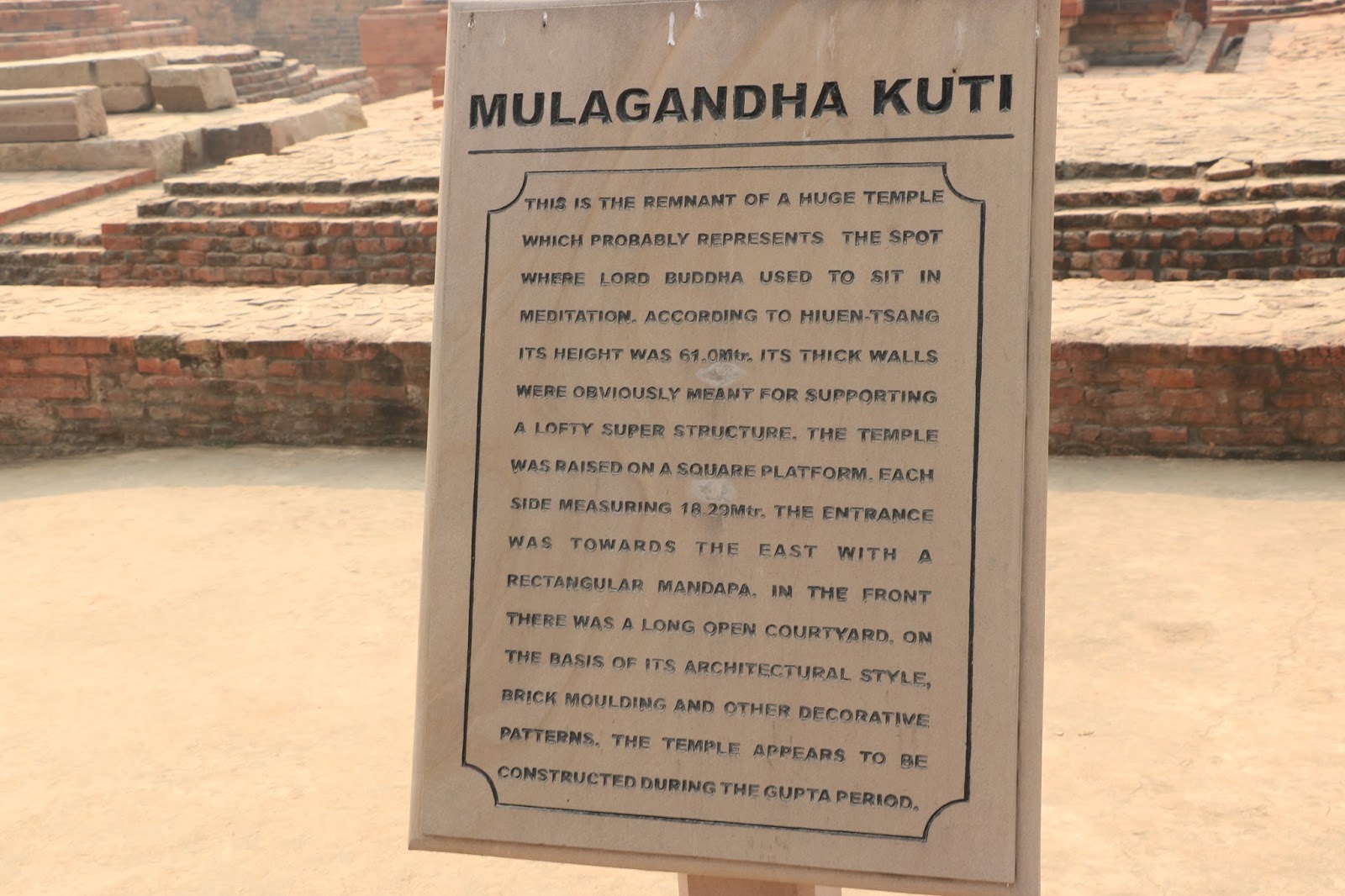
was built by King Asoka to commemorate the historical event. The original stupa was unfortunately destructed by Jagat Singh, a minister in Varanasi during the late 18th century in development of housing colony there, with the Buddha relic that was once enshrined here discarded, thinking that the relic is just a piece of junk rock. What is left is just the circular base of the stupa. Just beside the stupa is the ruins of the Mulagandhakuti or the First Perfumed Shrine where the Buddha spent his first rain retreat there. Located just beside the chamber is the fragments of the Asokan Pillar in Isipatana. The pillar fragments was enclosed with a transparent casing with the inscription still visible on the pillar. The Lion Capital of the pillar was displayed in the Sarnath Museum with other artifacts unearthed here in Migadaya.
Ruins of Mulagandhakuti
Description about the Mulagandhakuti
Fragments of Asokan Pillar

Description about the Asokan Pillar


Located not far towards the east was the Pancayatana Cetiya or the Shrine of Five Bases, the site where it was believed that the ordination of a rich man, Yasa as the Lord Buddha's sixth bhikkhu took place. In fact, Ven. Yasa's parents and siblings were the first batch of Lord Buddha's lay disciples. Amazingly, the texture and patterns engraved terracotta brick-made shrine were still clearly visible.
Remnants of Pancayatana Cetiya
Dhamekh Stupa or Dhamakha, the most prominent structure in Sarnath, was located further east from the Dhammarajika Stupa. The location of the stupa was believed to be the site where Lord Buddha expounded the second sermon, Anattalakkhana Sutta, the Discourse of Non-Self, where upon the accomplishment of the sermon, all the five ascetics attained Arahantship. There are burnt marks visible on the stupa which was believed to be the result of Jagat Singh's action. Here in Migadaya, Bro Tan shared with us the content of the Dhammacakkapavattana Sutta, including the two extremes to be avoided, the four noble truths and their aspects. At the end of the discourse, it was mentioned that only Ven. Kondañña understood the Lord's teaching at that time.
Dhamekh Stupa
Sarnath Archaeological Museum

In the afternoon, we visited the Sarnath Archaeological Museum, where most of the artifacts unearthed in Migadaya were put to display there, including the Lion Capital of the Asokan Pillar as well as some other Hindu artifacts. Due to the restriction by the museum authority, we were not allowed to bring any gadgets or devices into the museum. So, no pictures are taken for this visit. Anyway, we are so glad that we manage to see the polished sandstone-made Lion Capital which was still looks shiny as well as the well-carved Preaching Buddha-rupa. During the excursion, I got to know that actually the carvings of four animals that appeared on the Lion Capital represented the Blessed One's personalities and characteristics: Elephant - strength and latent tenacity; Bull - leadership and perseverance; Horse - swift and well-disciplined; Lion - fearlessness.


Mulagandha Kuti Vihara
In the evening, we went to the Mulagandha Kuti Vihara for our evening puja. Mulagandha Kuti Vihara was built by the Maha Bodhi Society under the efforts of Anagarika Dharmapala with financial assistance from Mrs Mary Elizabeth Foster of Hawaii in 1931. The Dhammacakkapavattana Sutta of different languages were displayed here. We also chanted the sutta for our evening puja. Fortunately, we also had the opportunity to pay our homage to the Buddha relics enshrined there. After that, we paid a short visit to the Jambudvipa Sri Lankan Buddhist Temple located not far from this vihara before returning to Varanasi.
Mulagandhakuti Vihara


River of Ganga
The next morning, we were excited to have the chance to go for a dawn cruise along the River of Ganga, the place which was deemed sacred to the Hindu communities in India. Various religious activities connected to their Hinduism culture were seen performed by the river. There are also some Indians performing laundry by the river. We also had the opportunity to have a glimpse at the cremation ghat where the bodies of the dead will be cremated there. Out of respect to the families of the dead, we were advised to to snap any photo there, but just silently and reflectively observe the activities carried out at the cremation ghat. During our cruise at the cremation ghat, we were reminded by Bro Tan about the samsaric cycle.

"How many had carried us and teared for us? How many had we carried and teared for? How long we need to continue with these over and over again? Think about it."

Yup. Due to our habits or kilesa, often we fell for samsaric trap, and continue that over and over again. To stop ourselves from indulging further, the right cultivation of mind is required, and that shall be each and everyone of us as a Dhamma practitioners' aspiration in freeing ourselves from that cycle of pleasurables and miseries. We carried out our morning puja and chanted Karaniya Metta Sutta on-board after the sun rises.
Cruising along the Ganga River with some historical building structure located along the river

An Indian lady performing laundry by the river

Sunrise at the Ganga River

The river ghat where we departed from


Back in the hotel, we performed meal dāna to the Sangha members from a university in Varanasi. We even have some conversations with them. It was quite enjoyable. After having our lunch, we packed and depart for La Bahadu Shastri International Airport. We felt utmost gratitude to our tour guide, Bro Rahul, the bus driver and also his attendant for ensuring our Dhammayatra journey in India a smooth one. We departed for Bangkok at 4.30pm Indian time and reached the Suvarnabhumi Airport at 9.00pm of Bangkok time.

That's all for Baranasi and Isipatana, the site where the Blessed One expounded the Four Noble Truth for the first time, resulting in the forming of Sangha community and the completion of the three refuges.

My Dhammayatra journey continues in Bangkok...